
23 Ways To Decorate The Wall Above Your Sofa
Decorating the wall above your sofa can help pull the whole living room together, but figuring out what belongs in such a prominent spot isn’t always easy. These ideas will give you inspiration for getting the scale and balance right while finding a look that works with the rest of your room.
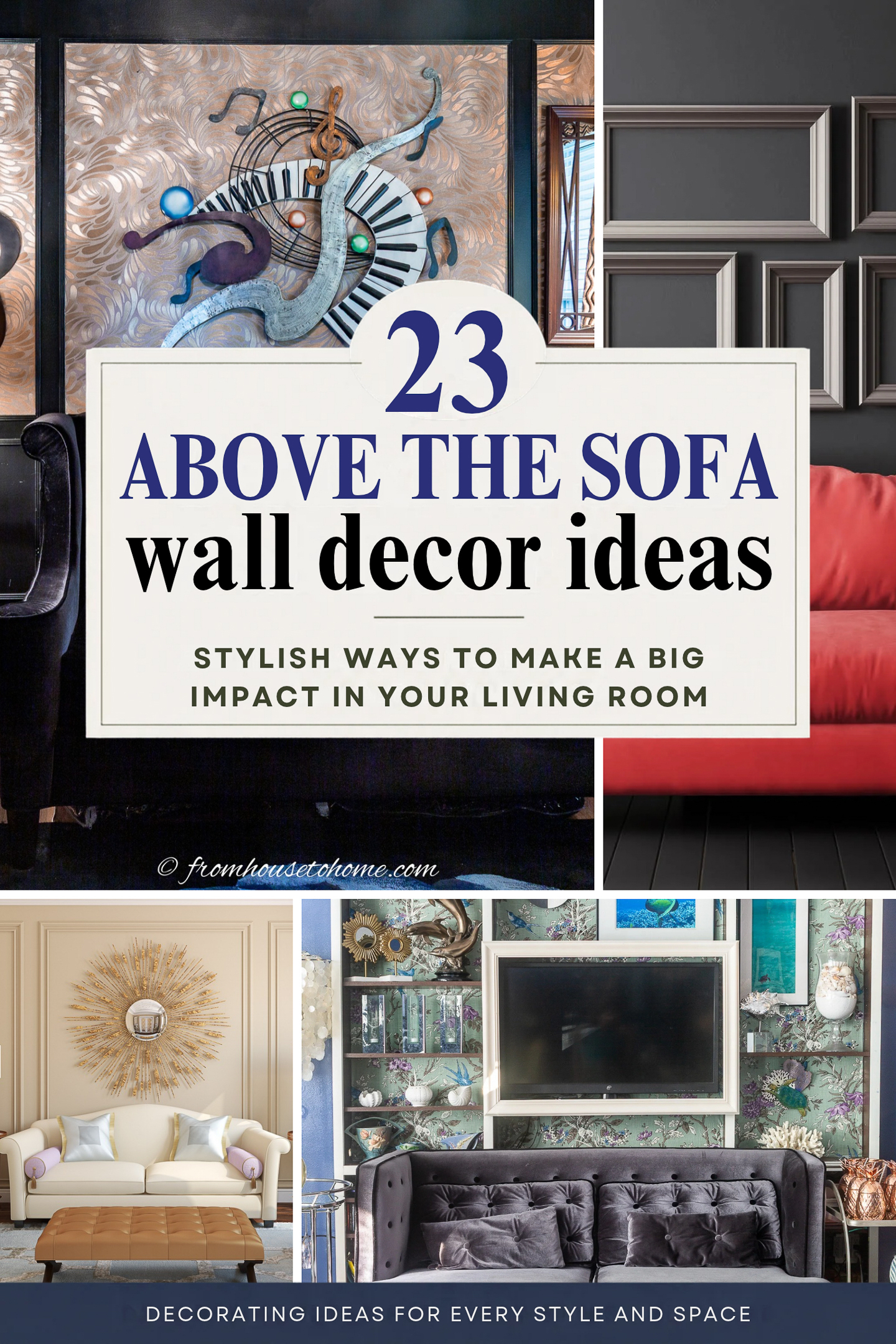
The wall behind the couch is one of the most noticeable areas in a living room because the sofa is usually one of the largest pieces of furniture in the space.
That makes whatever you put above it an important part of how the whole room looks.
Leaving the wall completely blank makes the room feel unfinished.
While wall decor that’s too small, too busy or out of proportion with the sofa makes the whole area feel unbalanced.
The tricky part is that there isn’t one solution that works for every sofa, every room or every decorating style.
The size and layout of the space matter, but so does what you like and how you want the room to feel.
These above the sofa wall decor ideas will give you plenty of inspiration for finding an approach that works with your room and gives it the look and personality you’re after.
1 | Hang one oversized piece of art
One large piece of art is one of the easiest ways to make the wall behind a sofa feel finished without creating a complicated arrangement.
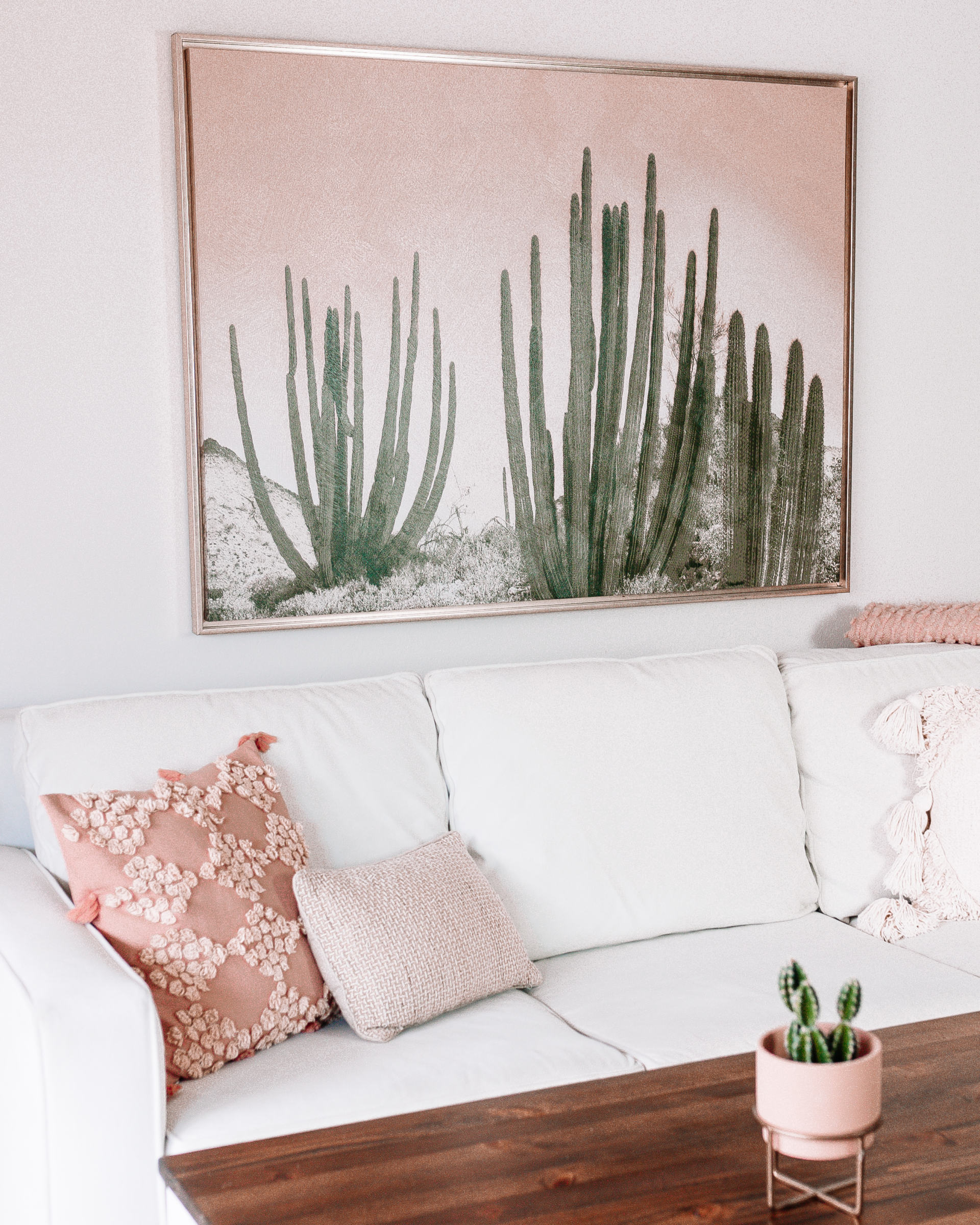
The oversized cactus print here is wide enough to balance the sofa below it, so it has enough visual weight to hold the wall on its own.
It also provides a color palette for the whole seating area.
Pulling a few colors from the artwork into your cushions, throw blankets and other accessories is an easy way to tie everything together, even when the pieces aren’t part of a matching set.
In this room, the pinks and greens from the artwork are repeated on the sofa, making the art feel connected to the rest of the space.
And if you can’t find (or afford) something this big, you can always create your own, using our large DIY wall art tutorial.
For this approach, scale is important. Look for artwork that’s large enough in relation to the sofa so it doesn’t look like it’s floating in the middle of a big empty wall.
Two large pieces of art can be easier to size for a sofa than one enormous piece, while still giving you a clean, uncluttered look.
In this room, the matching vertical canvases are hung side by side and centered over the sofa, so together they create the width of one substantial statement piece.
The similar colors and identical frames make the pair feel cohesive, but the artwork isn’t exactly the same, which keeps it interesting.
Leave only a modest gap between the pieces so your eye reads them as a set rather than two unrelated pictures.
3 | Make a statement with one large mirror
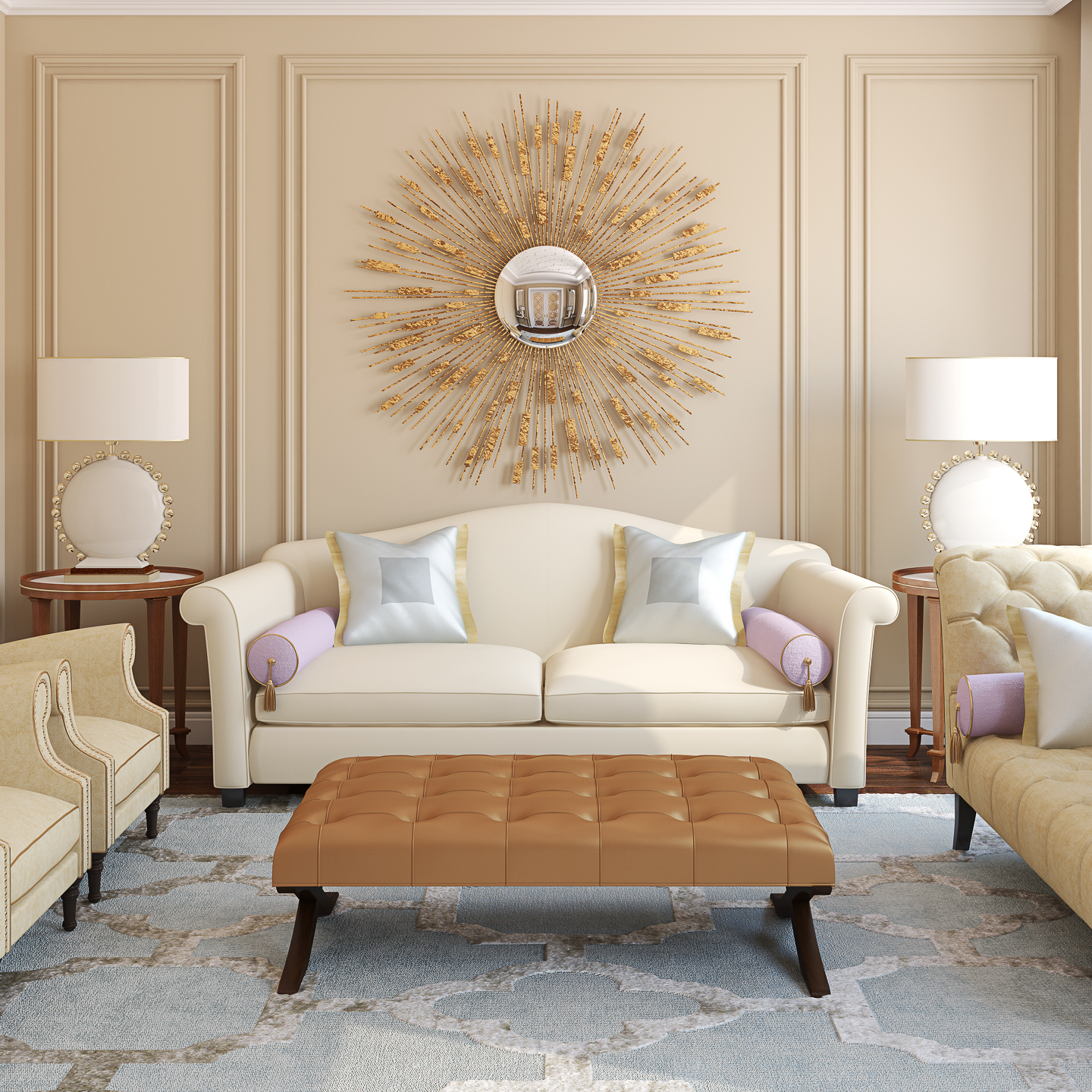
A large decorative mirror can fill the same role as oversized art while also reflecting light back into the room.
The sunburst mirror here has enough size and detail to stand on its own above the sofa, and its round shape breaks up all of the straight lines from the furniture, molding and windows.
Centering it over the sofa gives the wall a clear focal point, while the lamps on either side reinforce the symmetry.
A mirror with an interesting frame works especially well when you want the wall decor itself to add texture and shape.
A mirror doesn’t have to do all of the work on its own.
Flanking it with wall sconces creates a wider arrangement that is better proportioned to the sofa, while also adding another layer of light to the room.
In this space, a large round mirror is centered over the couch with matching sconces on either side.
The round shape breaks up the straight lines of the shelving behind it.
And the brass finishes on the mirror and sconces tie in with the other metal accents throughout the room.
This is an especially useful approach when you already have a mirror you love but it isn’t quite large enough to fill the wall by itself.
Instead of hanging one mirror over the sofa, you can also use a collection to fill a larger section of wall and add much more visual interest.
In this room, round mirrors in several sizes are mixed with sunburst shapes and other circular pieces, so the arrangement feels collected rather than like a matching set.
The dark wall makes the metallic finishes and reflective surfaces stand out, while the repeated round shapes keep all of those different pieces connected.
Start with the largest mirror near the center and build outward with smaller ones to get a similar layered look.
The wall behind the sofa is an easy place to repeat colors from the rest of the room, especially when you use a gallery wall with several different pieces of art.
This arrangement mixes bold coral, turquoise, yellow and green artwork with quieter pieces, so there is plenty of color without every frame competing for attention.
The frames themselves are mostly simple and neutral, which lets the artwork provide the variety.
Pulling a few of the colors from the artwork into the pillows below makes the wall and couch feel like part of the same design.
A gallery wall doesn’t have to stop at the edge of the sofa.
When you have seating that sits in a corner, continuing the artwork onto the adjoining wall makes the whole area feel connected.
This collection fills both walls from just above the sofa almost to the ceiling, turning the corner itself into part of the display.
The mix of large and small pieces keeps the arrangement from feeling too grid-like, while artwork placed close to the corner visually connects the two sides.
This approach is particularly useful when you have a large art collection to display, since you can make use of vertical space and adjoining walls rather than trying to squeeze everything into the area directly above the sofa.
This is a great way to decorate above a sectional since it treats both walls as one continuous display rather than leaving one side of the seating area looking unfinished.
When the wall already has beautiful molding, you don’t need to cover it up with a lot of art.
In this room, the ornate trim creates large panels that act almost like built-in frames for the pictures, scones and mirror.
The pieces don’t match exactly, but their placement within the molding gives each one a defined space and makes them feel balanced.
This is a good reminder to work with the architecture that’s already on the wall rather than automatically centering one large piece over the sofa.
9 | Add picture frame molding
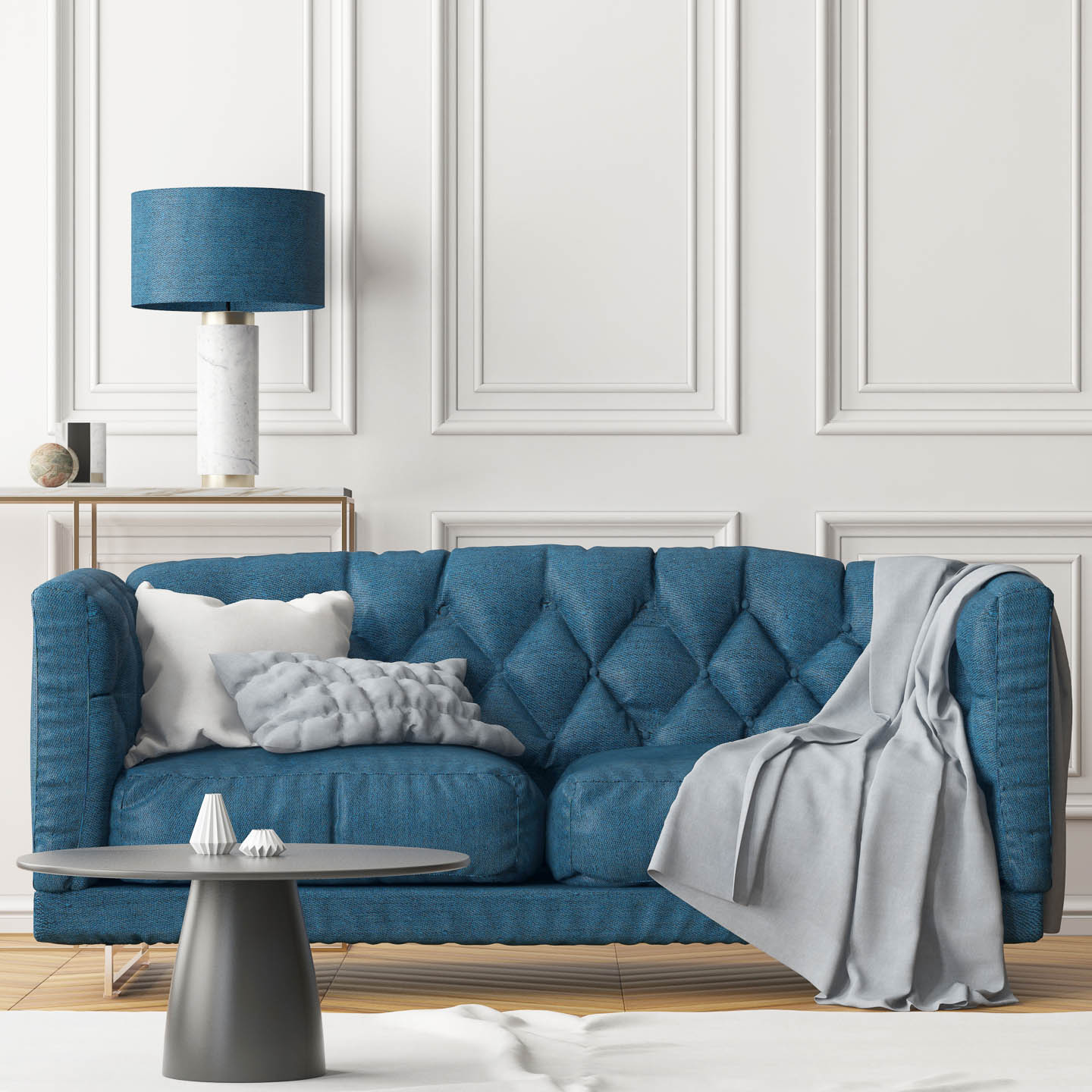
If your room doesn’t already have architectural details and you want some behind your sofa, picture frame molding is one of the easiest ways to add them.
The large rectangular panels here add depth and dimension to an otherwise plain wall, while painting the trim the same color as the wall keeps the effect subtle.
The panel layout also creates a natural frame for the sofa, so you don’t necessarily need to fill the space with artwork or other wall decor.
It’s a relatively simple way to give a basic wall some of the architectural character you might find in an older or custom-built home.
10 | Create architectural interest with empty frames
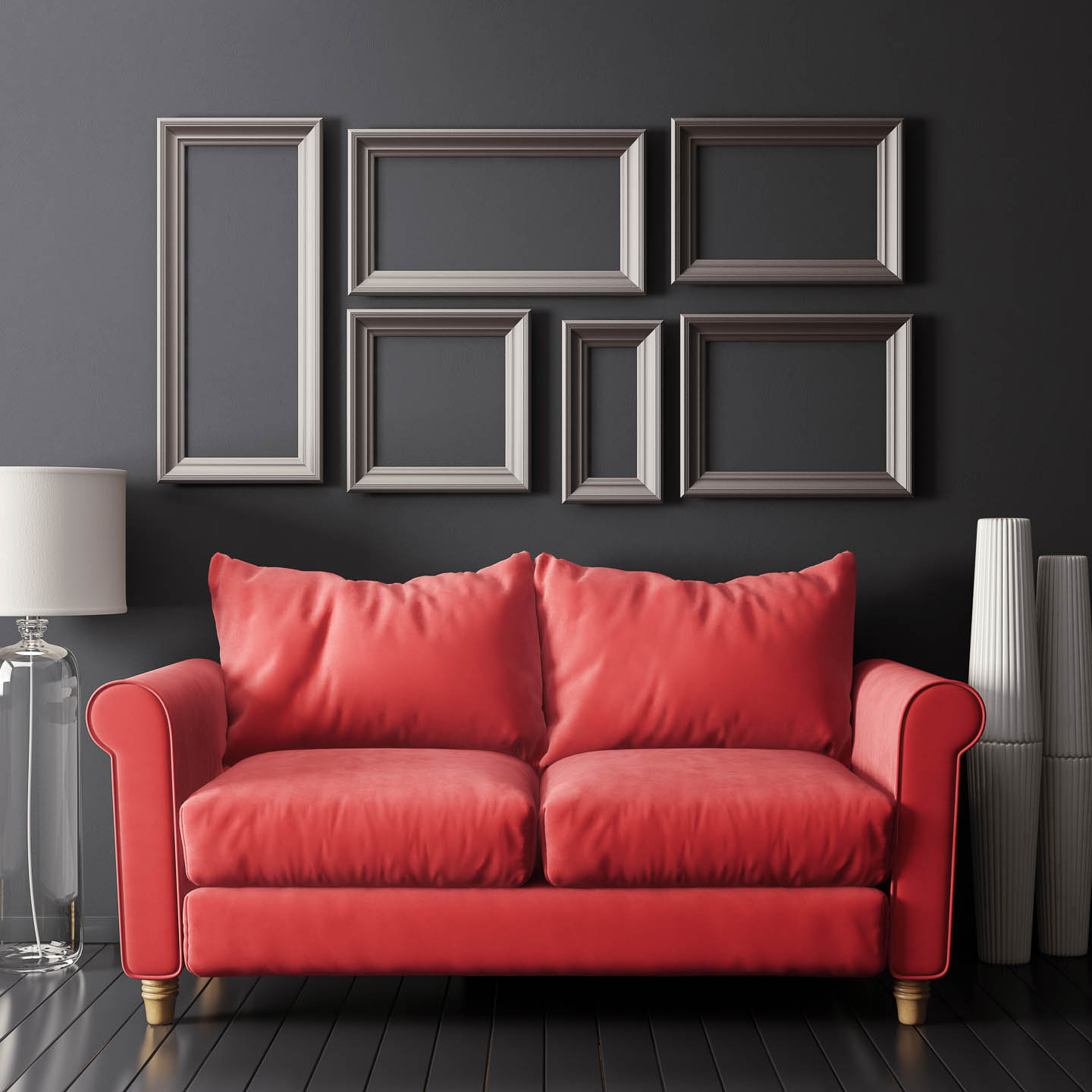
For a less permanent alternative to picture molding, try hanging a collection of empty frames on the wall instead.
You get a similar decorative effect from the rectangular shapes without having to cut and install molding.
This arrangement uses empty frames in several sizes to create a graphic display above the sofa, which makes the shapes and spacing themselves the decoration.
Keeping all of the frames in a similar dark finish ties the different sizes together, while the wall color shows through and becomes part of the design.
It’s also an easy way to put interesting frames you already own to use without having to find artwork for all of them.
A gallery wall can help balance a furniture arrangement that isn’t symmetrical.
Instead of centering all of the artwork over the couch, extend the display to include nearby furniture so everything feels like part of the same arrangement.
Here, the gallery wall stretches across both the sofa and the table beside it, visually connecting the two pieces and making the entire area feel more cohesive.
The artwork is arranged asymmetrically too, with different sizes, orientations and frame styles creating a collected look rather than a formal grid.
Repeating some of the frame colors and finishes throughout the display gives your eye something to connect, while the varied arrangement works with the uneven furniture placement instead of trying to make it look symmetrical.
A picture ledge is a great option if you like to change your wall decor without measuring and rehanging everything every time.
Here, a long narrow shelf runs above the sofa and holds a casual mix of framed art, photos and small objects.
Leaning the pieces instead of hanging them lets the frames overlap slightly, which gives the display more depth and makes it easy to add or remove something later.
Keeping the ledge roughly aligned with the width of the sofa helps the arrangement feel connected to the furniture below it.
If the wall behind your sofa needs to do more than hold a picture, built-in shelving can turn the whole area into a focal point and give you plenty of display space at the same time.
Here, dark wood shelves and cabinets frame the loveseat on both sides, while the open center keeps the seating area from feeling boxed in.
A single framed piece centered over the sofa gives your eye a place to rest, and repeating decorative objects across the shelves ties the entire wall together.
This works especially well in small living rooms where you need every extra inch you can get.
Instead of building bookshelves around the sofa, you can also place them directly behind it.
This gives you plenty of room for books and decorative objects without requiring a custom built-in arrangement, since freestanding bookcases can work just as well.
And since the sofa hides the lower shelves, they’re a handy spot for storing less attractive things you don’t need to access very often.
In this room, the white shelves blend in with the walls and the rest of the room, while the dark blue backs add a strong dose of color that is repeated in a couple of the sofa cushions.
Painting or wallpapering the backs of basic bookcases is an easy and inexpensive way to give them more of a custom look.
15 | Use wallpaper as the wall decor
When you want the entire wall behind the sofa to have an impact, wallpaper can do the decorating without requiring a large collection of framed art.
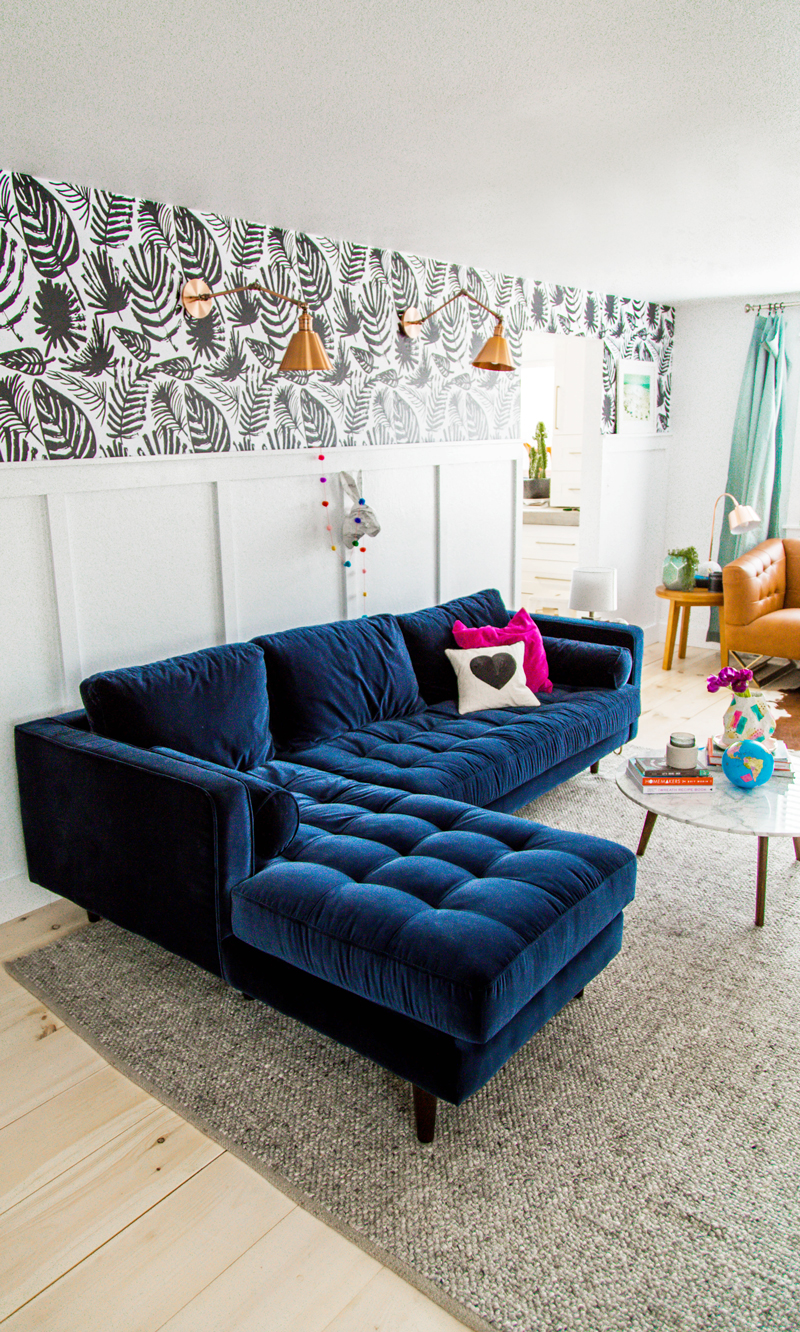
The graphic pattern in this room stretches across the wall and creates a strong backdrop for the dark blue sectional, while the lighter background keeps the pattern from making the space feel too heavy.
Because the wallpaper already has plenty going on, the rest of the wall can stay relatively simple.
This is also a useful trick when the sofa sits on a long wall that would be expensive or awkward to fill with individual pieces of art.
When your sofa sits along a long wall, you don’t have to limit the artwork to the space directly above it.
Extending a gallery wall across the entire wall turns the art collection into a statement feature for the room.
Here, framed artwork fills the wall from end to end and continues well above the sofa, so the display has much more impact than a smaller grouping centered over the seating.
Mixing different sizes, orientations and frame styles keeps such a large collection interesting.
While the closely spaced arrangement makes all of the individual pieces read as one big display.
This approach works especially well on a long, uninterrupted wall where a smaller arrangement could leave large stretches of empty space on either side of the sofa.
17 | Hang sculptural wall art
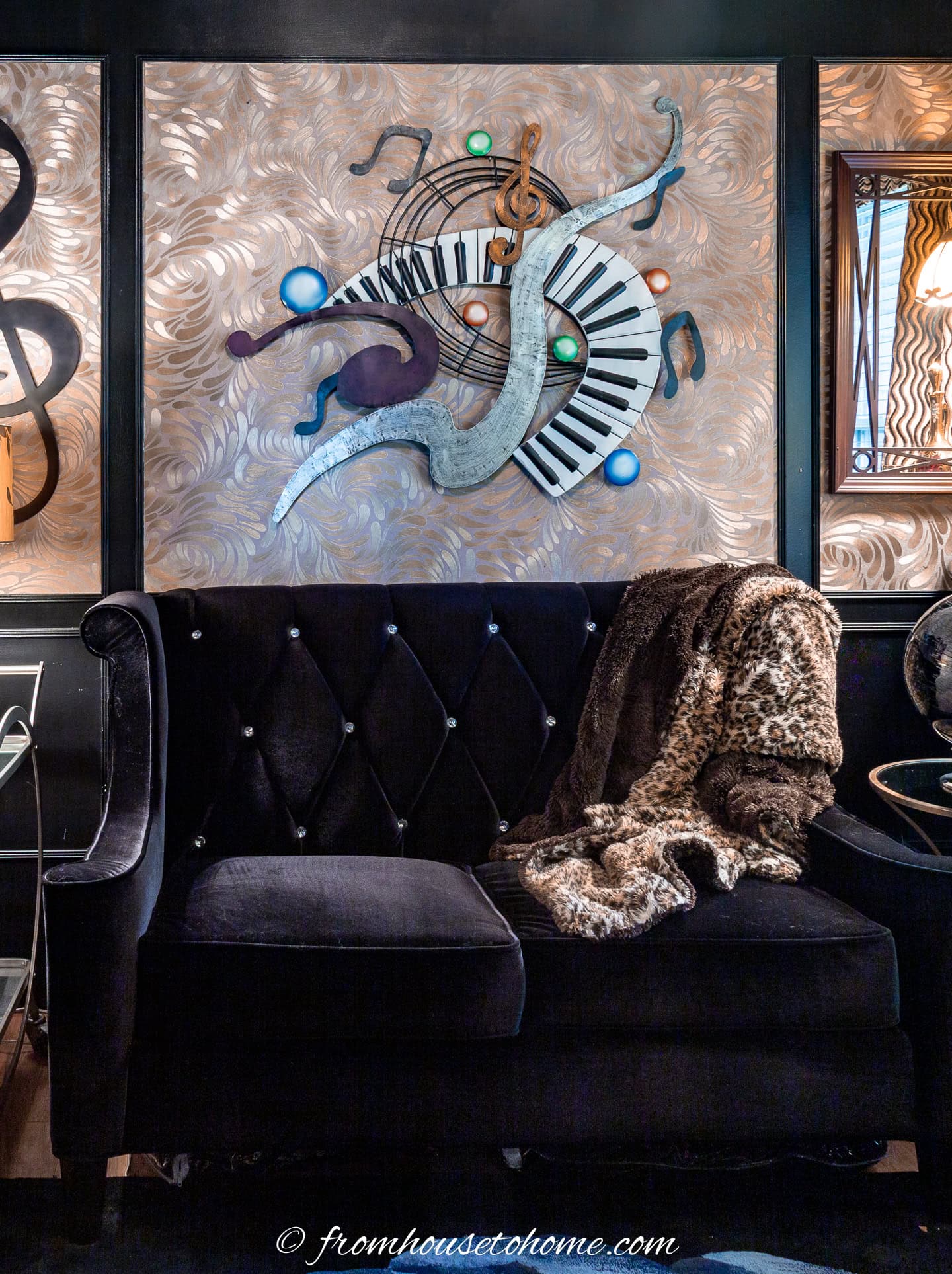
Flat framed art isn’t the only option for the wall behind a sofa.
A three-dimensional wall sculpture can add shape, texture and personality while still functioning as the main focal point.
This music-themed piece combines curved piano keys, notes and metal lines, so it has enough scale and movement to fill the large panel above the sofa on its own.
The metallic and dark finishes also stand out against the patterned wallpaper, which helps the sculpture stay visible even with a detailed background.
Wall decor doesn’t have to be something you hang.
Painting wide vertical stripes behind the sofa can turn the entire wall into a decorative feature before you add a single piece of artwork.
Here, alternating stripes in two shades create a subtle accent wall behind the sectional.
The vertical lines draw your eye upward, which helps emphasize the height of the room, while the similar colors keep the pattern from becoming too busy.
The three large black-and-white photographs add another layer to the wall without competing with the stripes.
Their simple arrangement and limited color palette let the painted pattern remain an important part of the overall design.
19 | Decorate with unexpected objects
Don’t limit yourself to artwork, mirrors and other pieces that are traditionally sold as wall decor.
Architectural pieces, vintage finds and other interesting objects can add much more character to the wall behind your sofa.
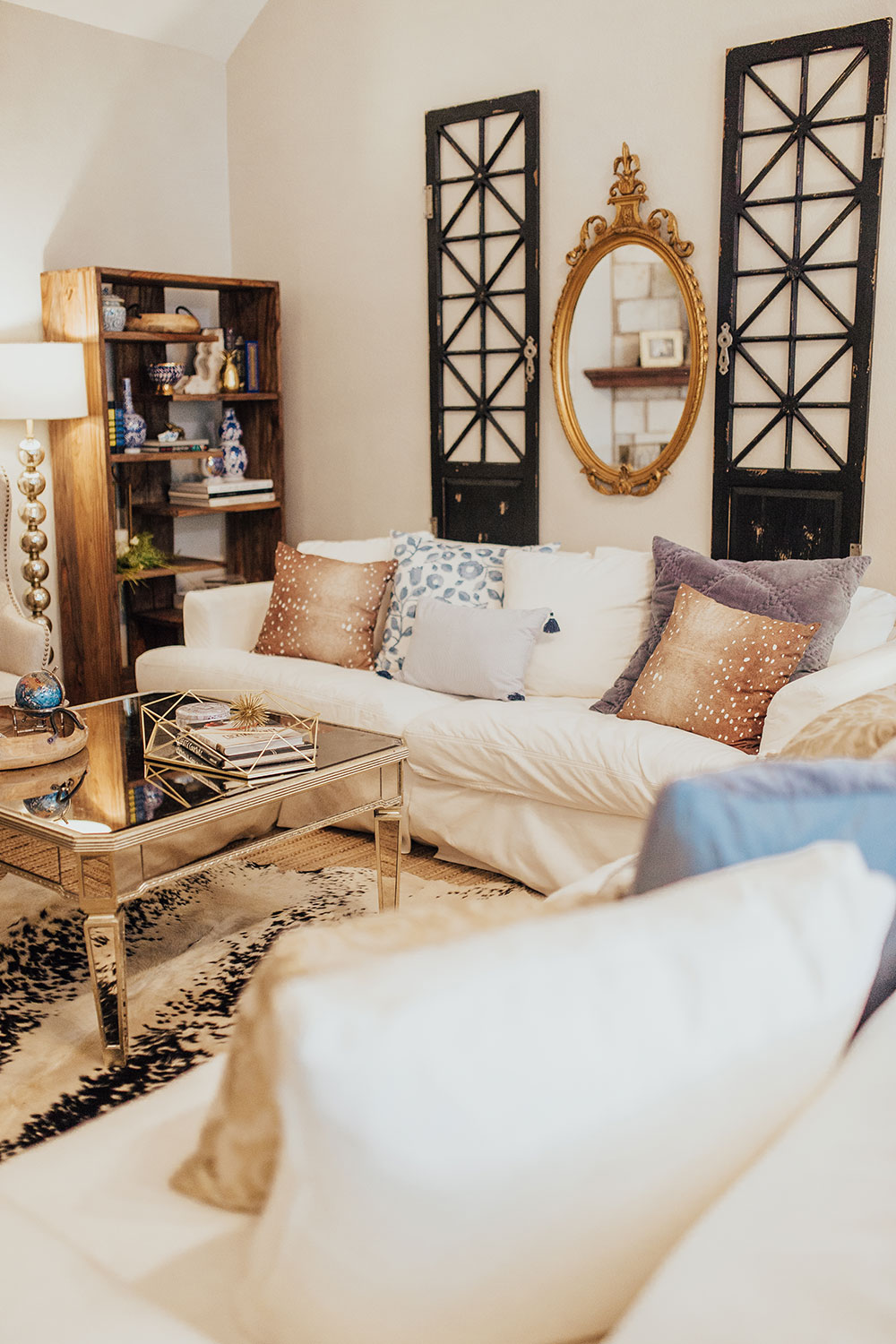
In this room, an ornate gold mirror is flanked by a pair of tall black doors, creating a large symmetrical arrangement from three very different pieces.
The height of the doors also helps fill more of the wall and draws your eye upward, while their dark finish makes the gold mirror stand out in the center.
It’s a good example of how repurposing unexpected objects can turn an otherwise ordinary wall into a focal point.
20 | Mount the tv behind the sofa
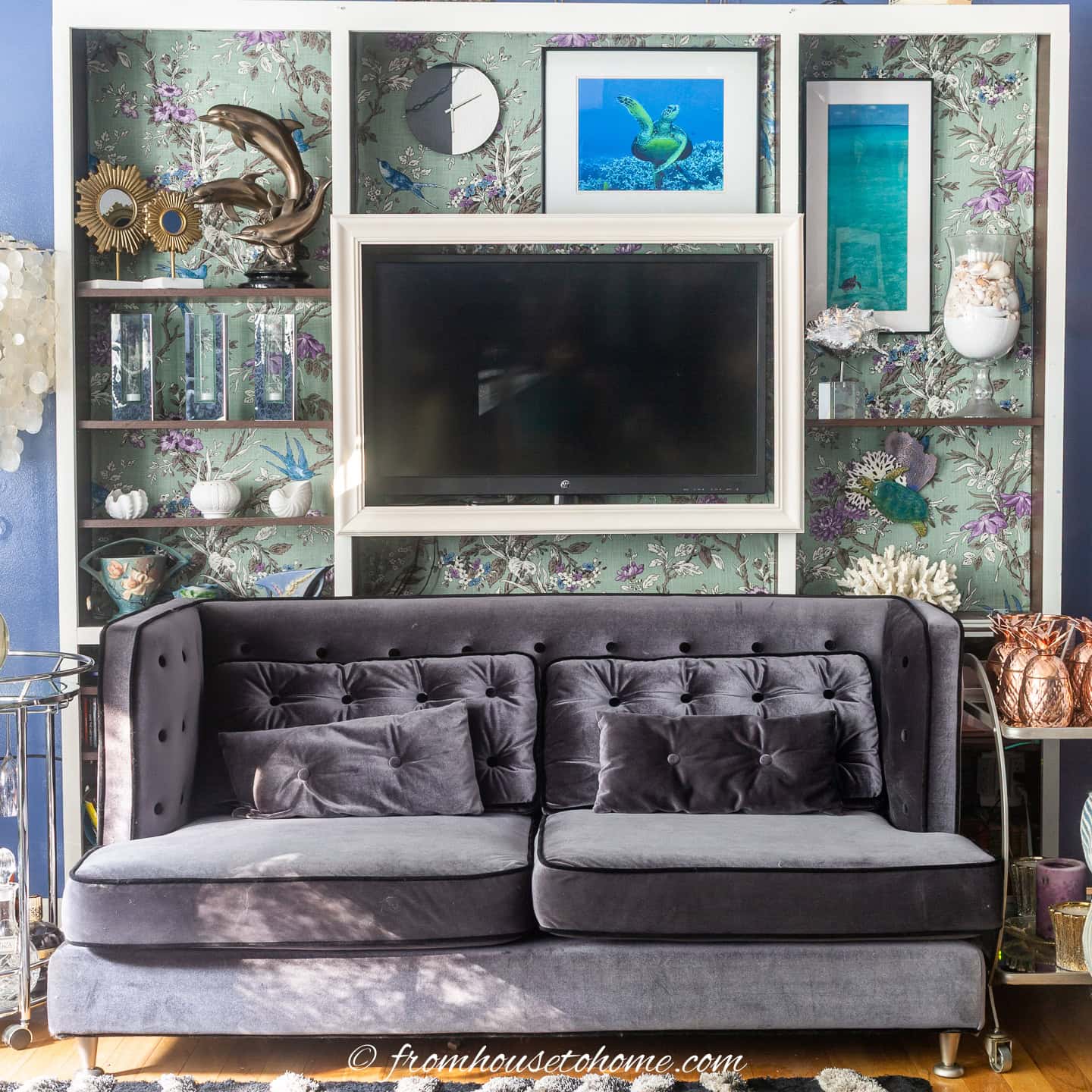
In a small living room, limited wall space can make it difficult to create a comfortable conversation area and still find a good place for the TV.
One option is to mount the television above a sofa rather than letting its placement dictate the layout of the entire room.
Then you can arrange additional comfortable seating where it works for conversation while also giving you a good view of the TV when you want to watch it.
Since the television becomes part of the wall behind the sofa, surrounding it with artwork helps incorporate it into the decor.
This wall mixes framed artwork in different sizes around the TV, while the pattern on the back of the bookshelf helps the screen blend into the background.
To do this, treat the TV as one of the larger rectangles in the arrangement, then build the gallery around it so the whole wall reads as one composition.
Related: How To Hide The TV With StyleWhen you have bookshelves behind the sofa, the things you put on them become part of the wall decor too.
Instead of treating the books as something that simply needs to be stored, arrange them in a way that adds color and pattern to the room.
Here, the books are grouped by color, creating bands of white, gray, red, orange and blue across the tall shelves. It turns a large book collection into a decorative feature without taking away any of the storage.
You don’t need enough books to create a full rainbow to use the idea. Grouping similar colors together in smaller sections can give your shelves a more cohesive look while still leaving room for other objects.
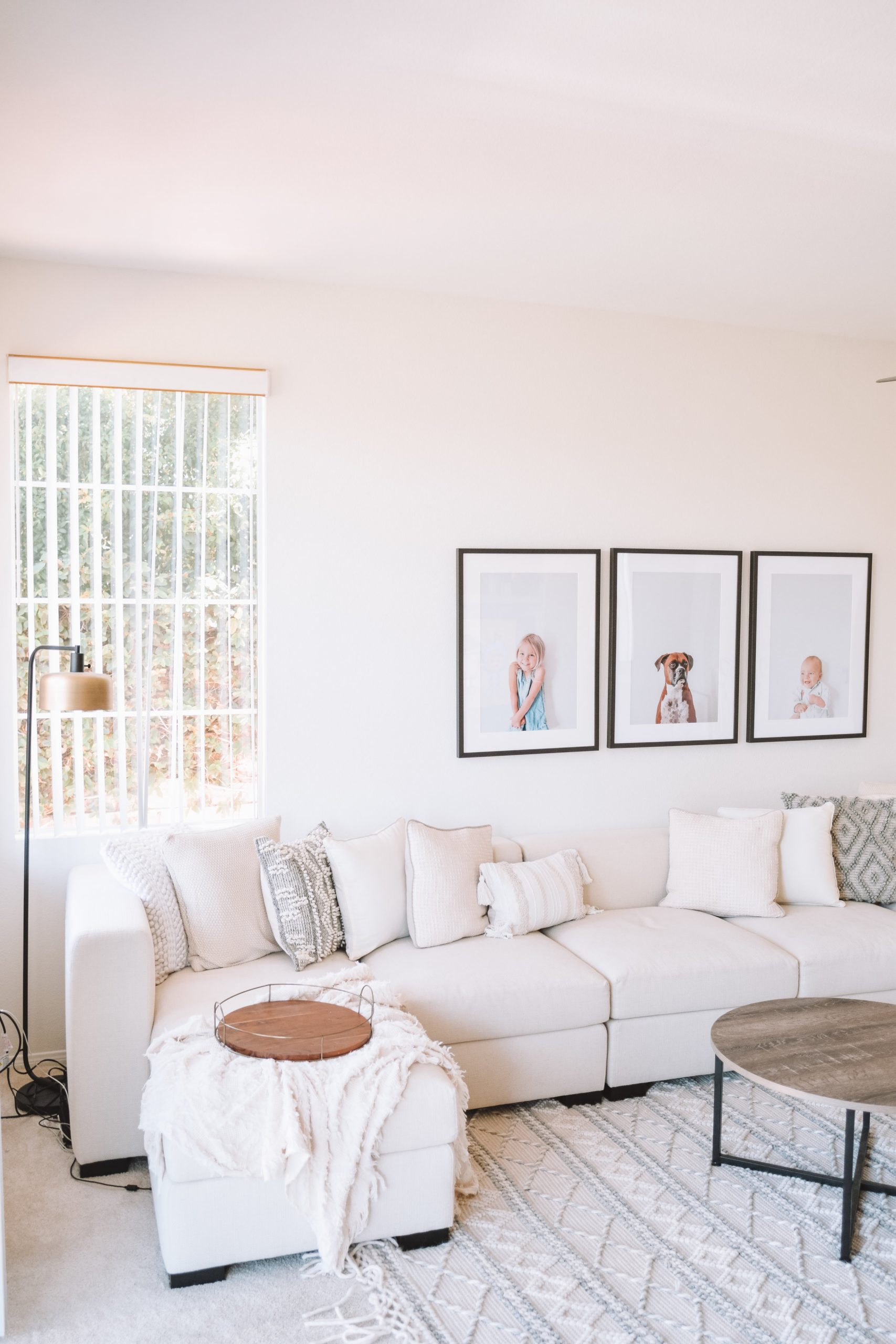
22 | Keep family photos simple and symmetrical
Family photos don’t have to become a large gallery wall to feel important.
A row of matching frames can create a quieter, more streamlined display that still personalizes the space.
Here, three similarly sized pictures are centered over the sofa and hung at the same height, so the repetition gives the arrangement more presence than the individual pieces would have on their own.
This works best when the frames and image style are consistent, since that symmetry is what makes a small grouping look deliberate rather than undersized.
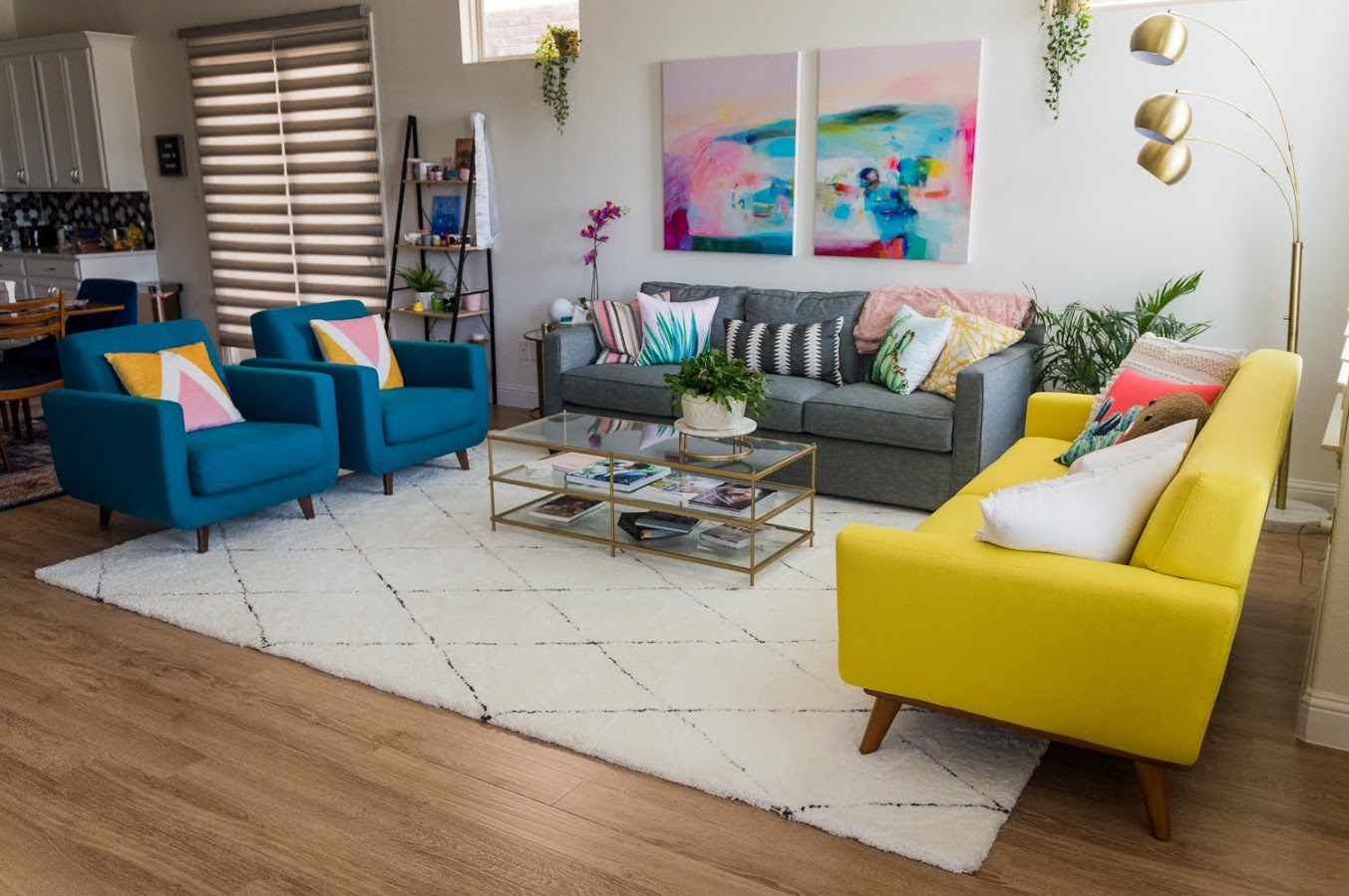
23 | Repeat the room’s colors in abstract art
Art above the sofa can do more than fill an empty wall. It can help pull the room’s color palette together.
The abstract pieces in this space repeat the bright blue, yellow and pink used in the chairs, pillows and accessories, which makes all of those strong colors feel connected.
Because the artwork is large and bold, the wall doesn’t need a lot of extra decoration around it.
This is a particularly useful approach in a colorful room where you want the wall decor to reinforce the palette rather than introduce another unrelated element.

Have comments or questions about our above sofa wall decor ideas? Tell us in the section below.